.svg)
Managing dispersed teams: practical strategies that works

Communication breakdowns, cultural misunderstandings, and sudden dips in productivity can leave even experienced leaders wondering what went wrong.
If your team is spread across cities, time zones, or job sites, you’re dealing with dispersed teams and managing them well should be your core leadership skill.
What are dispersed teams?
Dispersed teams are groups of employees who work together from multiple physical locations, often across regions or countries. They usually combine: onsite staff (e.g., hotel or store employees), remote workers (e.g., HQ, marketing, IT, support), hybrid roles moving between home and office
The defining characteristics:
- People rarely share the same physical space.
- Work is coordinated primarily through tools, not face‑to‑face contact.
- Different sites or roles may have considerable autonomy.
Examples:
- A hospitality group with HQ in one country and hotels in several regions.
- A construction firm running multiple sites with separate crews and a remote office team.
- A retail chain with stores across cities, plus a central operations team elsewhere.
Surveys from multiple workplace research firms suggest most global businesses now operate with some form of dispersed team, making this a mainstream management problem.
Core challenges & solution of managing dispersed teams
Dispersed teams are hardest to manage when the work is physical and local: cleaning, hospitality, construction, retail, maintenance, farming. In these environments, people are on their feet, often speak different languages or different literacy level.
Research from Gallup and others consistently shows that remote and dispersed workers are more likely to feel disconnected if leaders don’t actively counteract it.
Here are the main challenges and concrete ways to solve them.
Communication gaps and information silos
The challenge include:
- Shift changes and time gaps mean updates don’t reach everyone.
- Instructions get buried in WhatsApp or verbal handovers.
- HQ or managers assume messages were understood when they weren’t.
A new cleaning standard, a safety update, or a last‑minute client change can be missed entirely by the team that does the work.
Solutions
Use clear, simple formats:
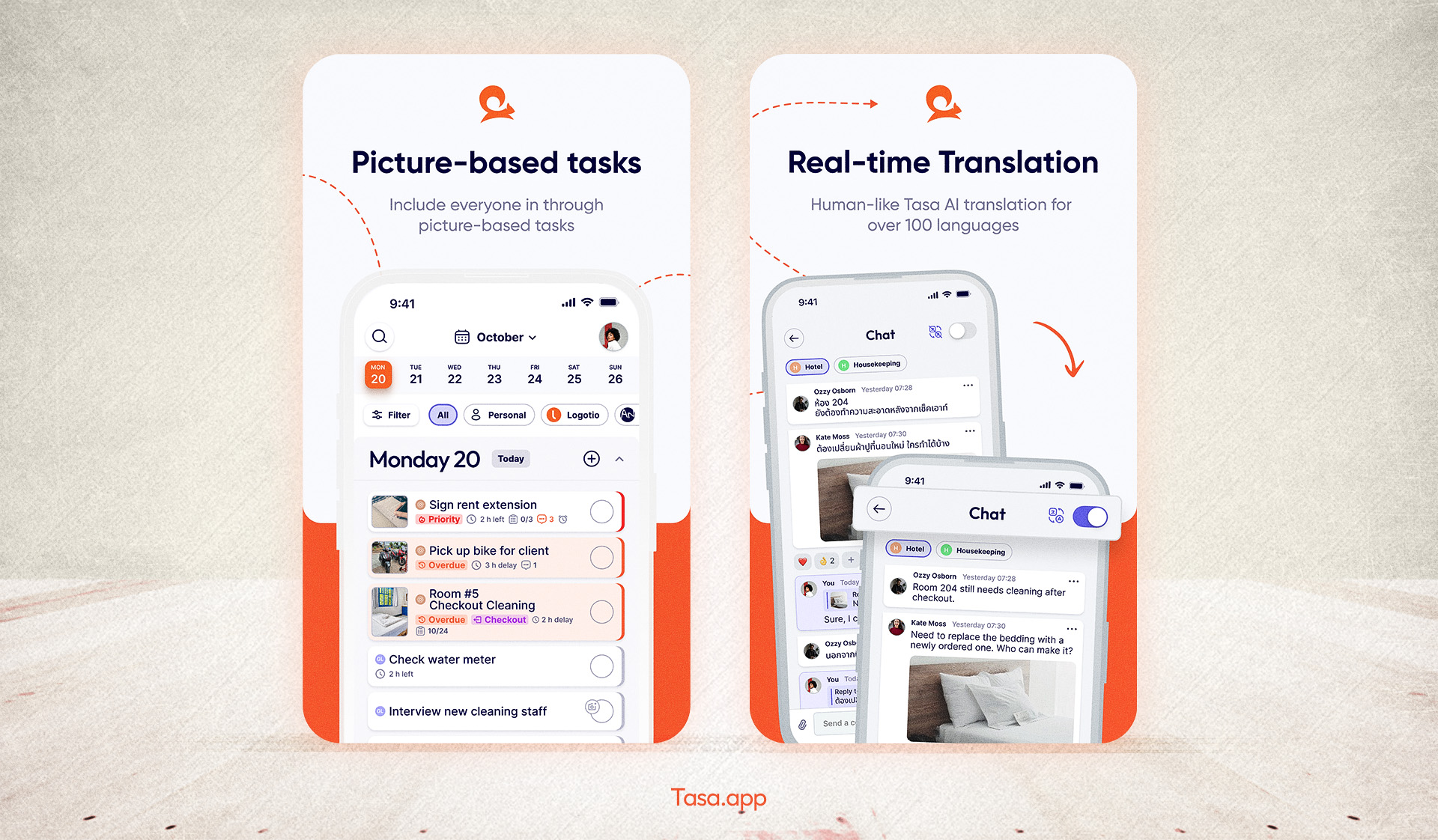
- Turn updates into picture-based tasks that appear on workers’ phones.
- Add photos to show exactly what needs to change.
- For cleaning or hospitality teams, link tasks to clear visual checklists:
Language and literacy barriers
Local crews are often multilingual and have mixed literacy levels:
- Expat or HQ managers give instructions in English or another language.
- Some staff can only read basic text, or in a different script.
- Verbal explanations are inconsistent and don’t scale.
This leads to different interpretations of the same task, leading to assumptions and more rework.
Solutions
- Use plain words and avoid idioms or slang in any written instruction.
- Add visuals:
Use photos, diagrams, and icons wherever possible.
Create one “golden” example photo for what “done right” looks like.
- Tasa makes this process easier
Tasks combine a photo + short text, making it easier for everyone to understand.
Built‑in AI translation lets you write tasks once (e.g., in English) and display them to staff in their own language.
This is especially useful for expats managing local teams:
Weak accountability
Out of sight is out of mind. When you can’t physically walk every site:
- It’s tempting to assume tasks were done because nobody complained.
- Field staff may tick checkboxes without fully doing the work.
- You only find issues when customers, guests, or inspectors call them out.
This makes it hard to know which sites and people are genuinely performing well.
Solutions
- Define “done” clearly:
Attach checklists to recurring tasks.
Make sure every task has an owner and due time.
- Add lightweight evidence:
For high‑risk or high‑impact work (safety, cleanliness, client deliveries), ask for photos or short notes.
This keep everyone accountable
Low engagement and “invisible” teams
Frontline dispersed teams often feel:
- Disconnected from HQ and leadership.
- Invisible compared to office-based colleagues.
- Uncertain whether anyone notices their work.
This kills motivation and increases turnover.
Solutions
- Regular check‑ins:
Short, scheduled calls or huddles for each site/crew to share updates and feedback.
Make time for questions, not just instructions.
- Visible recognition:
Celebrate good work and improvements in shared channels.
Share photos of jobs well done (with permission) in group chats or dashboards.
Inconsistent routines across locations
When each location or shift lead creates their own system:
- One site follows the latest SOPs; another sticks to old habits.
- Daily, weekly, and monthly routines vary widely.
- Training for new staff depends on who happens to show them the ropes.
This makes scaling very hard.
Solutions
- Standardize core routines:
Identify the critical daily, weekly, and monthly tasks for every site (opens, closes, checks).
Document them once, then reuse and refine.
- Use repeatable patterns:
Set up recurring tasks so people don’t have to remember everything.
Attach the same visual standards to each instance.
By addressing these core challenges with a mix of clear processes, the right tools, and visual, multilingual task systems, managing dispersed local and frontline teams becomes far less about constant firefighting and far more about steadily improving how work gets done.
Building and sustaining a high-performance dispersed team culture
Hiring, onboarding, and training
Good dispersed teams start with:
- Hiring people comfortable with autonomy and asynchronous work.
- Clear role definitions and expectations from day one.
- Onboarding that is standardized, documented, and easy to follow.
For frontline roles:
- Use visual onboarding where possible (videos, picture-based flows).
- Tasa support QR-based onboarding and on‑the‑job training via tasks.
Leadership and management routines
Solid routines for managers:
- Weekly team stand‑ups (short, focused on progress and blockers).
- Regular 1:1s (for development, not just status).
- Transparent KPIs that everyone can see.
- Consistent, respectful feedback across cultures.
Recognition, rewards, and growth
Dispersed teams need to feel: seen, Aappreciated, and able to grow.
Ideas:
- Public shout‑outs in team channels or all‑hands meetings.
- Small tangible rewards for big efforts (vouchers, gifts, extra time off).
- Clear paths for progression, regardless of location.
Research from multiple engagement studies (e.g., Gallup, StribeHQ) shows recognition significantly lifts morale and retention in distributed environments.
The future of managing dispersed teams
Looking ahead to the next few years:
- Flexible work models will remain standard (hybrid, remote‑first, work‑from‑anywhere).
- AI will increasingly assist with translation, scheduling, and basic support.
- Cross‑border compliance will get more complex as you hire in more jurisdictions.
- Younger talent will expect digital‑first collaboration, purpose, and growth pathways independent of location.
Leaders who do well will be those who:
- Design their org around dispersed work rather than fighting it.
- Invest in clear structures, good tools, and human‑centered leadership.
- Remember that tech is a means to an end: helping people do better work together.
Latest News


Have questions?
.svg)
Team management, simplified.
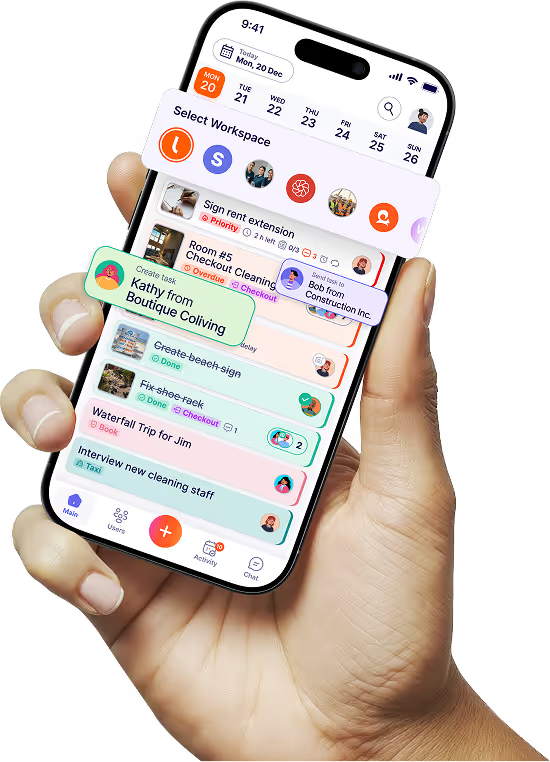

“It affects my personal life a lot. I can manage my team and my work remotely, so I have more time being a mother.”
