.svg)
The expert guide to multilingual staff app in 2026

Globalization is accelerating, and in 2026, managing a workforce that speaks five or more languages is the new norm. Yet, 60% of businesses say miscommunication in multilingual teams leads to costly mistakes and lost productivity, according to SHRM.
For expat entrepreneurs, hospitality managers, construction supervisors, and cleaning company owners, these language barriers can block growth, increase turnover, and create daily confusion. Adopting a multilingual staff app is now essential to overcome these hurdles, streamline team collaboration, and ensure everyone is on the same page.
This guide explores why a multilingual staff app is vital, what features matter, how to implement one, the best solutions, and future trends shaping global teamwork.
Why does your business need a multilingual staff app in 2026?
Expat entrepreneurs, hospitality managers, construction supervisors, and cleaning company owners all face a common challenge: effective communication across languages. If your workforce speaks more than one language, outdated processes can lead to costly mistakes and frustrated employees. A multilingual staff app is the bridge that brings clarity, trust, and efficiency to your diverse team.
What are the main challenges faced by multilingual teams?
Language differences can create major roadblocks:
- Communication breakdowns result in errors, accidents, and project delays.
- Cultural misunderstandings lower morale and trust.
- High turnover rates stem from frustration and feeling excluded.
- Legal risks increase in regulated sectors when instructions are misunderstood.
Imagine a hotel where five languages are spoken daily. Housekeeping may miss critical details, while front desk staff struggle to convey guest requests.
According to Deloitte, 70% of expat managers say language is their top operational hurdle.
Yet, when communication works, multilingual teams consistently outperform others.
Research reveals that nearly 70% of US enterprises face daily language challenges, proving that the right multilingual staff app is vital for overcoming these barriers and unlocking your team's full potential.
Why do traditional communication tools fall short?
Most legacy tools are not built for global teams:
- Text-heavy apps alienate staff with low literacy or limited language skills.
- Built-in machine translation often misinterprets industry terms.
- Visual task management is missing, leaving room for confusion.
- Information gets buried in endless message threads, increasing the risk of missed tasks.
|
Feature |
WhatsApp/Slack |
Multilingual Staff App |
|---|---|---|
|
Real-time translation |
Limited/inaccurate |
Yes, high accuracy |
|
Visual instructions |
No | Yes |
|
Task tracking |
Manual |
Centralized |
“Legacy tools weren’t built for today’s global teams,” says Anna Keller, HR Tech Analyst.
This is why a specialized multilingual staff app is essential to ensure every message lands with clarity.
How can a multilingual staff app transform productivity?
The right multilingual staff app changes everything:
- Real-time translation minimizes costly errors and eliminates double work.
- Picture-based instructions help non-readers and low-literacy workers perform tasks confidently.
- Centralized dashboards track tasks, boosting accountability and transparency.
For instance, cleaning company using a multilingual staff app reduced onboarding time by 50%, saving hours each week.
"Universal design" means every worker, regardless of language or reading ability, can participate fully.
Gartner reports that companies using multilingual solutions see 33% higher staff engagement. By choosing a solution like Tasa, you empower every team member and lay the groundwork for stronger collaboration, smoother operations, and lasting business growth.
What features should you look for in a multilingual staff app?
Selecting the right multilingual staff app can make or break your team’s productivity. For business owners managing diverse teams, the right features mean fewer errors, faster onboarding, and higher morale. Let’s break down exactly what matters most in 2026:
- Real-time AI translation
- Picture-based instructions
- Collaboration tool

Why is real-time AI translation essential?
Real-time AI translation is the backbone of any effective multilingual staff app. It supports over 100 languages, making global hiring seamless. With instant translation, you no longer need to rely on a handful of bilingual supervisors.
Here’s how manual and AI translation compare:
|
Method |
Speed |
Accuracy |
Cost |
|---|---|---|---|
|
Manual |
Slow |
Medium |
High |
|
AI Translation |
Instant |
High |
Low |
On construction sites, for example, mixed crews use the multilingual staff app to avoid costly mistakes and delays.
As Anna Keller, HR Tech Analyst, says,
“Legacy tools weren’t built for today’s global teams.”
For a deeper dive into the essentials of multilingual communication, check out Multilingual communication essentials.
How do picture-based instructions improve clarity?
Visual instructions are a game-changer for teams with varying literacy levels. A multilingual staff app that allows managers to send photos, diagrams, or checklists ensures everyone understands tasks, regardless of language skills.
- Housekeeping teams can use task photos for instant manager approval.
- Cleaning crews follow step-by-step visuals for complex jobs.
- Visual workflows help retain information up to 400 percent better.
Universal design means your app includes everyone—from new hires to seasoned pros, no matter their reading ability.
This approach bridges communication gaps, boosts inclusion, and reduces costly errors on the floor.
What collaboration tools matter most for diverse teams?
Collaboration goes beyond chat. The best multilingual staff app offers:
- Voice and video messaging for nuanced feedback.
- File sharing for plans, checklists, and safety documents.
- Company chat with threads for context.
- Advanced notifications so tasks aren’t missed.
- Multi-role and multi-team support for operational flexibility.
These features keep dispersed teams connected and accountable, driving both productivity and satisfaction.
In summary, choosing a multilingual staff app with these features transforms communication challenges into business opportunities. Tasa stands out for its intuitive design and robust translation, making it a top pick for hospitality, cleaning, and construction teams.
How do you implement a multilingual staff app step-by-step?
Successfully implementing a multilingual staff app can feel overwhelming, especially if your team is juggling multiple languages and roles. The right approach ensures every employee, from front desk to field crew, feels included and empowered. Here’s a proven pathway to integrate your new multilingual staff app for maximum impact.
What’s the best way to assess your team’s language needs?
Start by mapping out your team’s language landscape. Survey staff to determine their language proficiency, preferred communication methods, and any literacy challenges.
- Identify where misunderstandings most often occur.
- Pinpoint which workflows break down due to language gaps.
- Compare the needs of different departments, such as front desk versus housekeeping or site supervisors versus laborers.
For example, a hospitality team may need instant translation at the front desk, while cleaning crews benefit from visual task lists. By clarifying these needs, you can tailor your multilingual staff app setup for each role. This groundwork reduces friction later and helps you prioritize features that matter most.
How do you choose and onboard the right app?
Selecting the best multilingual staff app starts with evaluating industry fit and usability. Look for solutions that are proven in your field and easy for everyone to adopt, even those new to digital tools.
- Shortlist apps with strong translation, visual instructions, and multi-role support.
- Pilot the app with a small team and gather honest feedback.
- Use QR-code onboarding to let staff join quickly, without technical headaches.
A practical resource like the Managing dispersed teams guide can help you anticipate common challenges and streamline your rollout. Remember, the smoother the onboarding, the faster your team sees results.
Comparison table: Onboarding methods
|
Method |
Speed |
Ease for Staff |
Common Issues |
|---|---|---|---|
|
Manual |
Slow |
Low |
Errors, confusion |
|
QR-code |
Fast |
High |
Tech limitations |
What are best practices for training and adoption?
Effective rollout of your multilingual staff app hinges on inclusive training and ongoing support. Provide multilingual training materials, including videos and visual guides, so every team member can learn at their own pace.
- Assign “champions” in each department to help colleagues and answer questions.
- Set up recurring checklists in the app to build habits and consistency.
- Monitor usage metrics to spot gaps or disengagement early.
Example: On a construction site, safety checklists in multiple languages ensure compliance and reduce accidents. Regular feedback sessions keep the app aligned with real-world needs.
Key Implementation Tip
Universal design is critical—choose a multilingual staff app that everyone can use, regardless of language or literacy level.
By following these steps, you transform communication, boost morale, and lay the groundwork for business growth. The right multilingual staff app empowers every employee to contribute their best, no matter where they come from.
Which multilingual staff apps lead the market in 2026?
Choosing the right multilingual staff app can make or break your team’s productivity. The market is crowded, but only a few platforms truly address the needs of expat entrepreneurs, hospitality managers, and supervisors leading diverse teams.
Why is Tasa a top choice for multilingual teams?
Tasa stands out as a leading multilingual staff app in 2026, built specifically for diverse workforces. It uses picture-based instructions, making daily tasks simple for both high and low-literacy staff. AI-powered translation covers over 100 languages, letting teams work together without confusion.
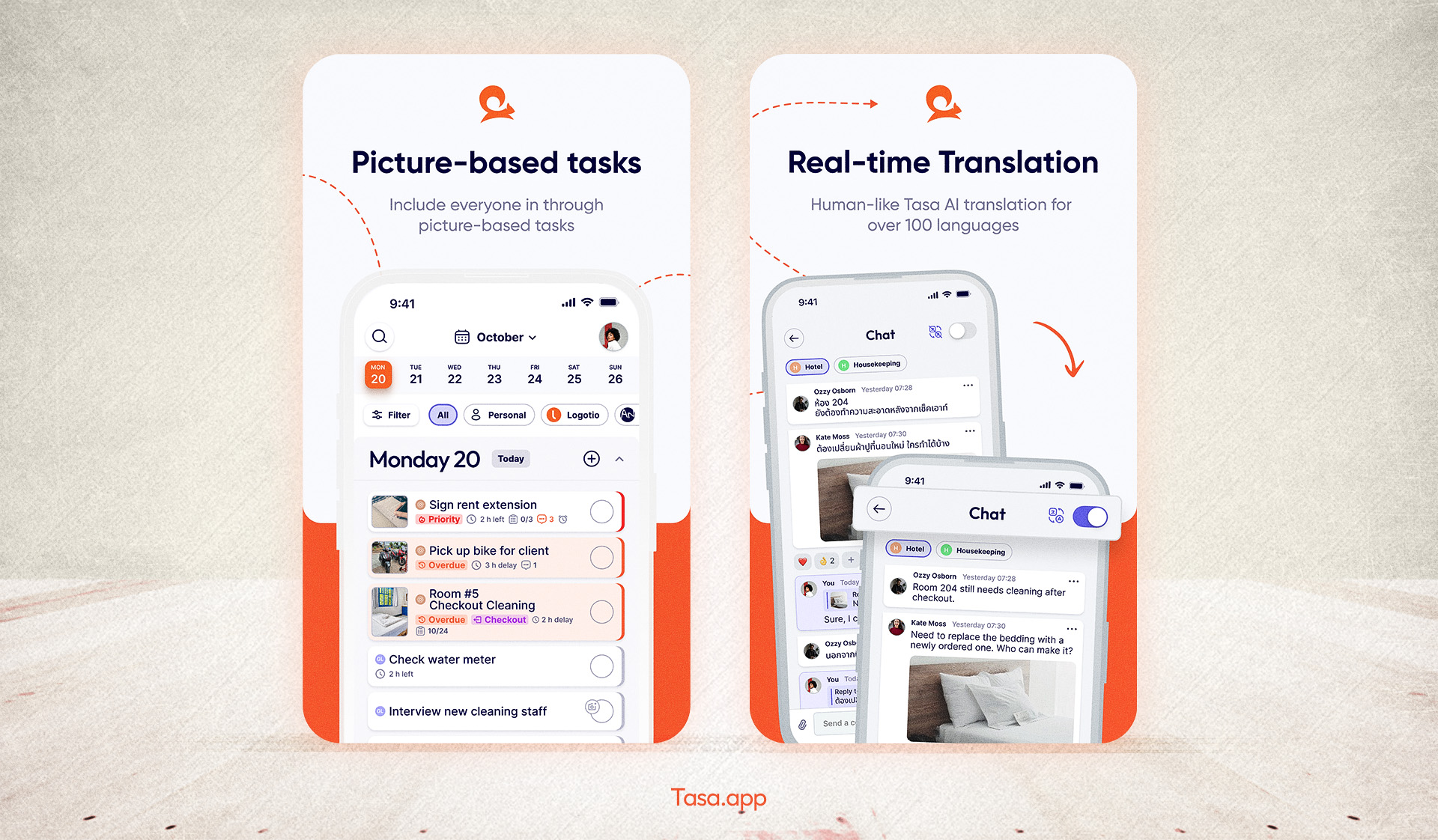
- Visual task flows and checklists for instant clarity
- Real-time translation, reducing manual back-and-forth
- Multi-role dashboard for managers and team leads
- 60% less time spent on manual communication
Tasa is especially effective for hospitality and cleaning teams. For details, see how the app for hospitality teams transforms cross-language collaboration.
Universal design in Tasa ensures every staff member, regardless of reading level or language, can complete tasks confidently.
What other leading apps are available?
Other top multilingual staff app options include Connecteam and Beekeeper, both popular in hospitality and construction. Here’s how they stack up:
Latest News


Have questions?
.svg)
Team management, simplified.
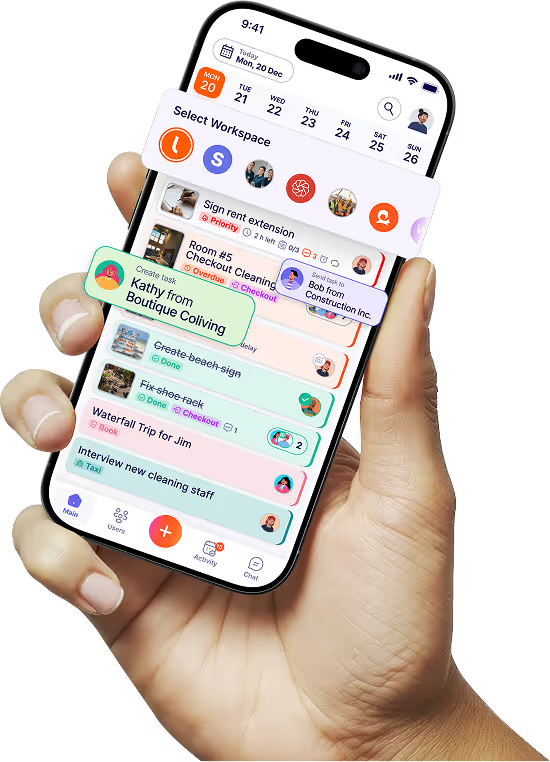

“It affects my personal life a lot. I can manage my team and my work remotely, so I have more time being a mother.”
